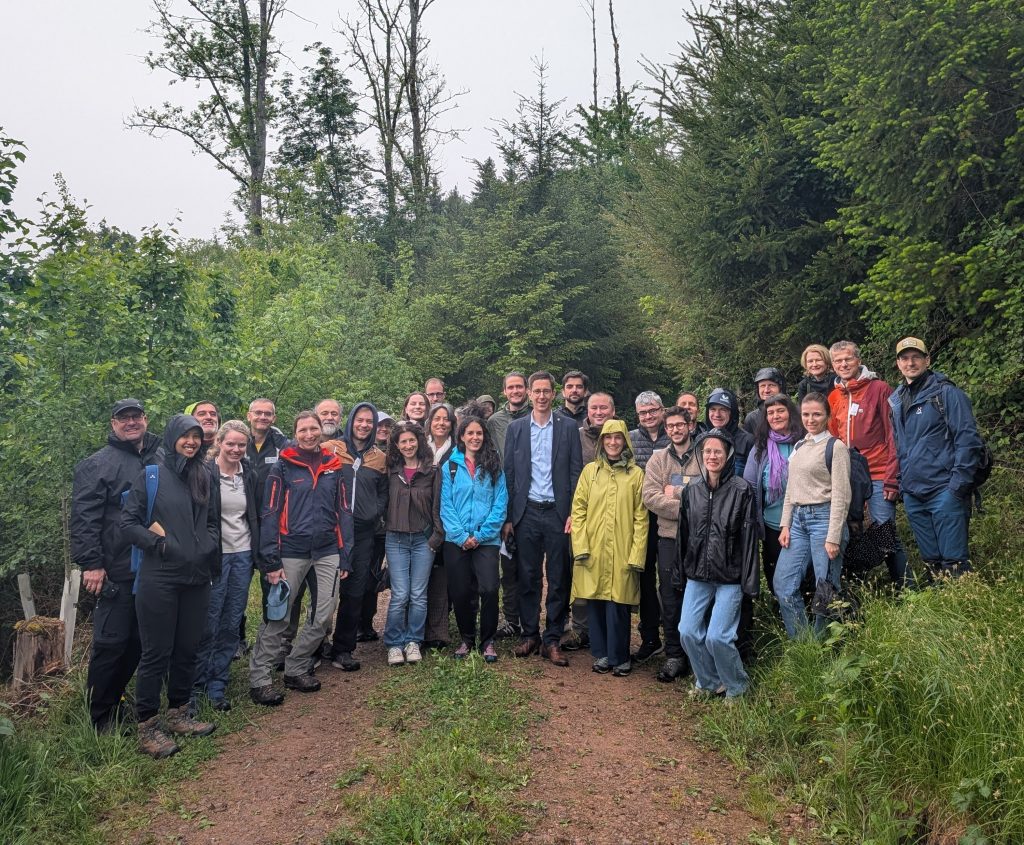
On 5 May 2026, WaldBeiderBasel and the Forstkammer Baden-Württemberg welcomed partners of the Small4Good consortium for an excursion through LivingLab Central. The visit brought together researchers and practitioners from across the project to exchange knowledge and explore innovative approaches to sustainable forest management in Germany and Switzerland.
The excursion featured three forest sites, each demonstrating different strategies for addressing some of the key challenges facing European forests today, including climate adaptation, biodiversity conservation, digitalisation, and the provision of ecosystem services.
STOP 01 · Wehr, Germany · Reforestation after bark beetle infestation
Renewal out of damage: a forest owner’s bet on diversity
The first stop took participants to Wehr, Germany, where a forest area severely affected by bark beetle infestation has been transformed through active reforestation efforts. Rather than replanting what was lost, forest owner Denis Schmiak has embraced a deliberately mixed species approach, creating a more resilient ecosystem better equipped to cope with future climate conditions and disturbances. The consortium walked through areas still marked by the damage alongside young stands already showing the first signs of a more resilient forest taking hold. It was a vivid reminder that climate adaptation in the forest is not a future ambition it is already underway, plot by plot.
STOP 02 · Therwil, Basel-Landschaft · Marteloscope & digital forest tools
Where every tree has a data point, and a decision attached to it
The second stop brought the consortium to a marteloscope, a precisely inventoried forest plot where every tree has been tagged and measured, turning a patch of woodland into a living classroom for forest management decisions. Hristina Hristova demonstrated how 360° video and digital inventory tools allow forest areas to be documented and modelled, making it possible to simulate the long-term effects of different management choices before a single tree is felled or retained.
Alongside the digital dimension, Jonas Vögtli from the Angenstein forestry district grounded the visit in everyday practice. His work in the area centres on balancing competing demands on the same forest: timber production, biodiversity promotion, the preservation of habitat trees for rare species, and the recreational expectations of a peri-urban public. The Therwil stop made clear that digital tools are most powerful not as replacements for this kind of on-the-ground knowledge, but as ways to make it more communicable, more scalable, and more legible to decision-makers and forest owners alike.
STOP 03 · Lange Erlen, Basel · Forest as water infrastructure
More than ten million cubic metres: a forest doing quiet, essential work
The final stop may have been the most striking in its simplicity. On the edge of Basel city, the Lange Erlen forest is not managed primarily for timber, biodiversity, or recreation though it delivers all three. Its primary function, as Thomas Meier and Janik aus den Erlen from IWB explained, is filtering drinking water. Through a system of infiltration basins and natural percolation, the forest processes over ten million cubic metres of water annually, effectively serving as a piece of critical urban infrastructure that happens to look like a forest.
The Lange Erlen visit was a compelling close to the day’s itinerary: a reminder that the economic and social value of forests is almost always greater than what can be captured in a timber price or a biodiversity index. Here, the forest earns its place in the urban water supply chain. An argument for protection that speaks the language of infrastructure planners as much as it speaks to ecologists.
Learning from practice
The LivingLab Central excursion brought into focus a truth that underpins the entire Small4Good project: small forest owners are not passive observers of change, but active shapers of it. From the bark beetle clearings of Wehr to the marteloscope plots of Therwil and the water-filtering woodlands of Basel, each site demonstrated that meaningful forest stewardship requires the right mix of local knowledge, practical commitment, and, increasingly, the digital tools to translate that knowledge into decisions that last.