
|
|
Small4Good Consortium Visits Living Lab Central: Exploring Climate-Resilient and Multifunctional Forest Management

Small4Good Consortium Visits Living Lab Central: Exploring Climate-Resilient and Multifunctional Forest Management

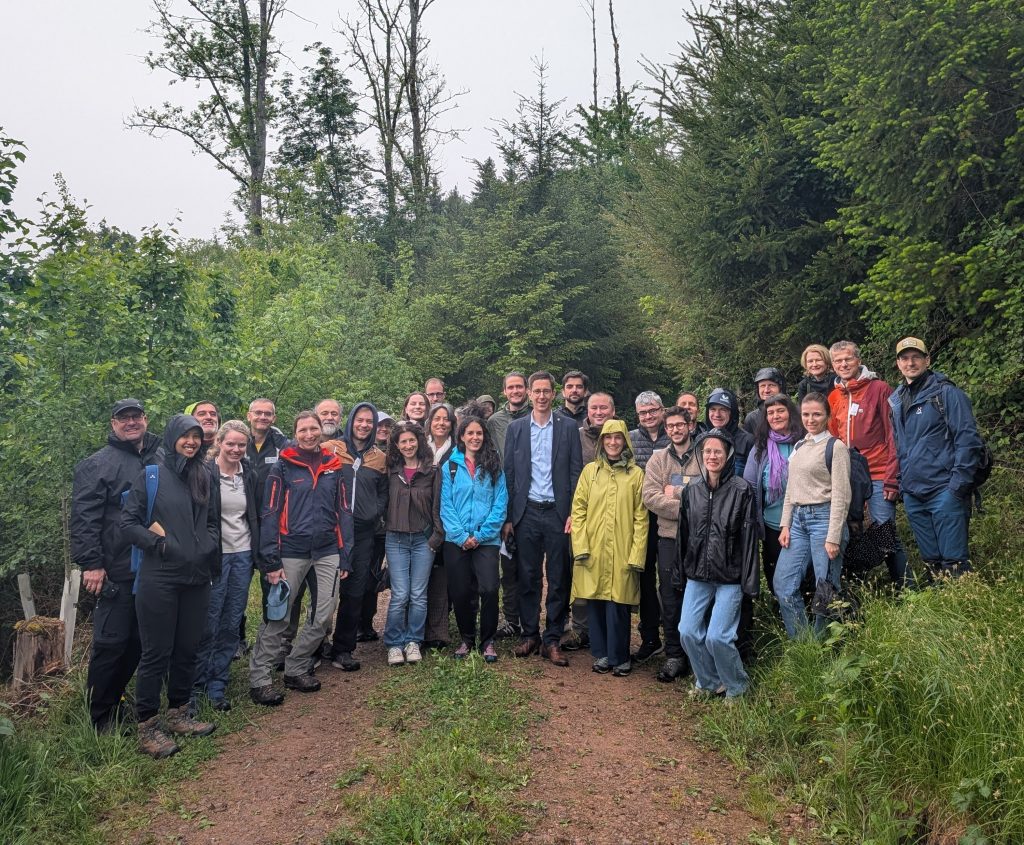
On 5 May 2026, WaldBeiderBasel and the Forstkammer Baden-Württemberg welcomed partners of the Small4Good consortium for an excursion through LivingLab Central. The visit brought together researchers and practitioners from across the project to exchange knowledge and explore innovative approaches to sustainable forest management in Germany and Switzerland.

The excursion featured three forest sites, each demonstrating different strategies for addressing some of the key challenges facing European forests today, including climate adaptation, biodiversity conservation, digitalisation, and the provision of ecosystem services.

The first stop took participants to Wehr, Germany, where a forest area severely affected by bark beetle infestation has been transformed through active reforestation efforts. Rather than replanting what was lost, forest owner Denis Schmiak has embraced a deliberately mixed species approach, creating a more resilient ecosystem better equipped to cope with future climate conditions and disturbances. The consortium walked through areas still marked by the damage alongside young stands already showing the first signs of a more resilient forest taking hold. It was a vivid reminder that climate adaptation in the forest is not a future ambition it is already underway, plot by plot.

The second stop brought the consortium to a marteloscope, a precisely inventoried forest plot where every tree has been tagged and measured, turning a patch of woodland into a living classroom for forest management decisions. Hristina Hristova demonstrated how 360° video and digital inventory tools allow forest areas to be documented and modelled, making it possible to simulate the long-term effects of different management choices before a single tree is felled or retained.

Alongside the digital dimension, Jonas Vögtli from the Angenstein forestry district grounded the visit in everyday practice. His work in the area centres on balancing competing demands on the same forest: timber production, biodiversity promotion, the preservation of habitat trees for rare species, and the recreational expectations of a peri-urban public. The Therwil stop made clear that digital tools are most powerful not as replacements for this kind of on-the-ground knowledge, but as ways to make it more communicable, more scalable, and more legible to decision-makers and forest owners alike.

The final stop may have been the most striking in its simplicity. On the edge of Basel city, the Lange Erlen forest is not managed primarily for timber, biodiversity, or recreation though it delivers all three. Its primary function, as Thomas Meier and Janik aus den Erlen from IWB explained, is filtering drinking water. Through a system of infiltration basins and natural percolation, the forest processes over ten million cubic metres of water annually, effectively serving as a piece of critical urban infrastructure that happens to look like a forest.

The Lange Erlen visit was a compelling close to the day’s itinerary: a reminder that the economic and social value of forests is almost always greater than what can be captured in a timber price or a biodiversity index. Here, the forest earns its place in the urban water supply chain. An argument for protection that speaks the language of infrastructure planners as much as it speaks to ecologists.

The LivingLab Central excursion brought into focus a truth that underpins the entire Small4Good project: small forest owners are not passive observers of change, but active shapers of it. From the bark beetle clearings of Wehr to the marteloscope plots of Therwil and the water-filtering woodlands of Basel, each site demonstrated that meaningful forest stewardship requires the right mix of local knowledge, practical commitment, and, increasingly, the digital tools to translate that knowledge into decisions that last.
The current image has no alternative text. The file name is: 2026_s4g_consortium_AndreasGabriel-scaled.jpg

Privacy Policy

At Small4Good we take the protection of your personal data very seriously. Our purpose is to protect the privacy of the data you provide us and to comply with the current regulations on the protection of personal data.

In compliance with the Act 3/2018 of 5 December on the Protection of Personal Data and Guarantee of Digital Rights transposing Regulation (EU) 2016/679, we inform you of the following information about our privacy and data protection policy:

Who the controller of the processing of your data?

The organization responsible of your data is Norwegian University of Bioeconomy Research. This is a Research Institute located in Ås, Norway.

Address
PO Box 115 NO-1431
Telephone
+47 406 04 100

What is the purpose of the treatment?

  • To respond to requests, complaints and incidents transferred through our contact channels incorporated in the website.
  • To understand the behavior of the navigator within the web in order to detect possible computer attacks on our web.
  • Comply with legal obligations that are directly applicable to us and regulate our activity.
  • To protect and exercise our rights or to respond to complaints of any kind.
  • Submission of newsletters regarding the goods or services that make up the activity of the responsible person or news related to his activity.

What is the legal base of the treatment?

The legal basis for the treatment of your data is the consent of the data subject under article 6.1 a) of the Regulation, as well as the legitimate interest of the data controller under article 6.1 f) of the Regulation.

The data we request from you are adequate, relevant and strictly necessary and in no case are you obliged to provide them to us, but their non-communication may affect the purpose of the service or the impossibility of providing it.

For how long do we keep your data?

Your data will be kept for the time required for the proper provision of the service offered, as well as to meet the responsibilities that may arise from it and any other legal requirement.

Which recipients will receive your data?

While processing your data, Norwegian University of Bioeconomy Research may share your data with:

On Projects Advising SL, as web management and maintenance service providers.

What are my rights?

  • Right of access: the right to obtain confirmation of whether personal data is being processed, as well as the right of access to such data.
  • Right to rectification of personal data.
  • Right to erasure
  • Right to limitation of processing
  • Right to data portability
  • Right to object: the right to object to data being processed.

The controller retains the right to restrict the rights set forth in Article 23 of the EU Regulation, if such restriction is provided to safeguard, in particular fundamental rights and freedoms and is a necessary and proportionate measure.

Where can I make a complaint?

If any interested party considers that their data are not being treated correctly, they can send their complaints to the following e-mail address; stephan.hoffmann@nibio.no

The data subject declares to have acquired all this information.

Cookies Policy

A cookie is a file that is downloaded and executed on your computer, phone, or mobile device when you access certain web pages. Cookies allow a website, among other things, to store and retrieve information about user’s browsing habits and recognize the user depending on the information they contain and the way they use their computer.

Cookies do not harm your computer and are necessary to facilitate navigation.

What are cookies used for on our website?

Cookies are necessary for our website to work properly. The purpose of our cookies is to improve the user’s browsing experience. They can be used to remember your preferences (language, country, etc.) during navigation and on future visits.

The information collected in the Cookies also allows us to improve the website and adapt it to the individual interests of users, speed up searches, etc.

What types of cookies does our website use?

Analysis Cookies: These, if they are used properly by us or by third parties, allow us to quantify the number of users and thus perform the measurement and statistical analysis regarding the users’ usage of our service.

Advertising Cookies: These, if they are used properly by us or by third parties, allow us to manage as effectively as possible the supply of advertising space on the website, adapting the content of the advertisement to the content of the service requested or to the use you make of our website.

What we will NOT use cookies for

Our cookies do not store information about your personal identification, address, password, credit or debit card details, etc.

Who uses the information contained in these cookies?

The information stored in the website’s cookies is used exclusively by us, apart from those identified below as “third party cookies”, which are used and managed by external entities to provide us with services to improve our own services and the user’s experience when browsing our website.

Third party cookies are mainly used to obtain statistics and to guarantee the payment operations are carried out.

Can I prevent cookies from being used?

Yes, firstly, you must disable cookies in your browser and, secondly, delete the cookies stored in your browser associated with this website. 

You can restrict, block, or delete cookies from this website at any time by modifying your browser settings. This setting is different for each browser. For more details on the configuration of cookies in your browser, please consult your browser’s “Help” menu.

It is possible that some of the website’s features may no longer work if you disable cookies.

List of cookies that our website uses

Technical and customization cookies

These Cookies are used to identify the user during the session, prevent the user from having to repeat authentication processes on the website, speed up some website processes, remember selections made during the session or on subsequent accesses, remember pages already visited, etc.

COOKIES PURPOSE DURATION MANAGEMENT
User identification
They are used to identify and authenticate the user. They also contain technical data from the user session, such as connection timeout, session identifier, etc.
Session
Small4Good
Session identification
They identify the user’s http session. They are common in all web applications to identify requests from a user’s session.
Session
Small4Good
Navigation status
They help identify the user’s browsing status (login, first page, first access, scroll status, voting status, etc.).
Session
Small4Good
Navigation analysis cookies

These Cookies obtain generic information about users’ accesses to the website (not the content of the same) to subsequently provide us with information about these accesses for statistical purposes.

COOKIES PURPOSE DURATION MANAGEMENT
Google Analytics (__utma, __utmb, __utmc, __utmd, __utmv, __utmz, _ga…)

They allow website statistic’s tracking through the Google Analytics tool, which is a service provided by Google to obtain information about user access to websites. Some of the data stored is: number of times a user visits the website, dates of the user’s first and last visit, duration of visits, from which page the user accessed the website, which search engine was used or which link was clicked, from which part of the world the user accessed the website, etc. The information generated by the cookie about your use of the website will be directly transmitted and stored by Google Inc (a company located in United States). The configuration of these cookies is predetermined by the service offered by Google, so we suggest you consult the Google Analytics privacy page, for more information on the cookies it uses and how to disable them (keep in mind that we are not responsible for the content and accuracy of third-party websites).

Persistent
Third Parties
Skip to content